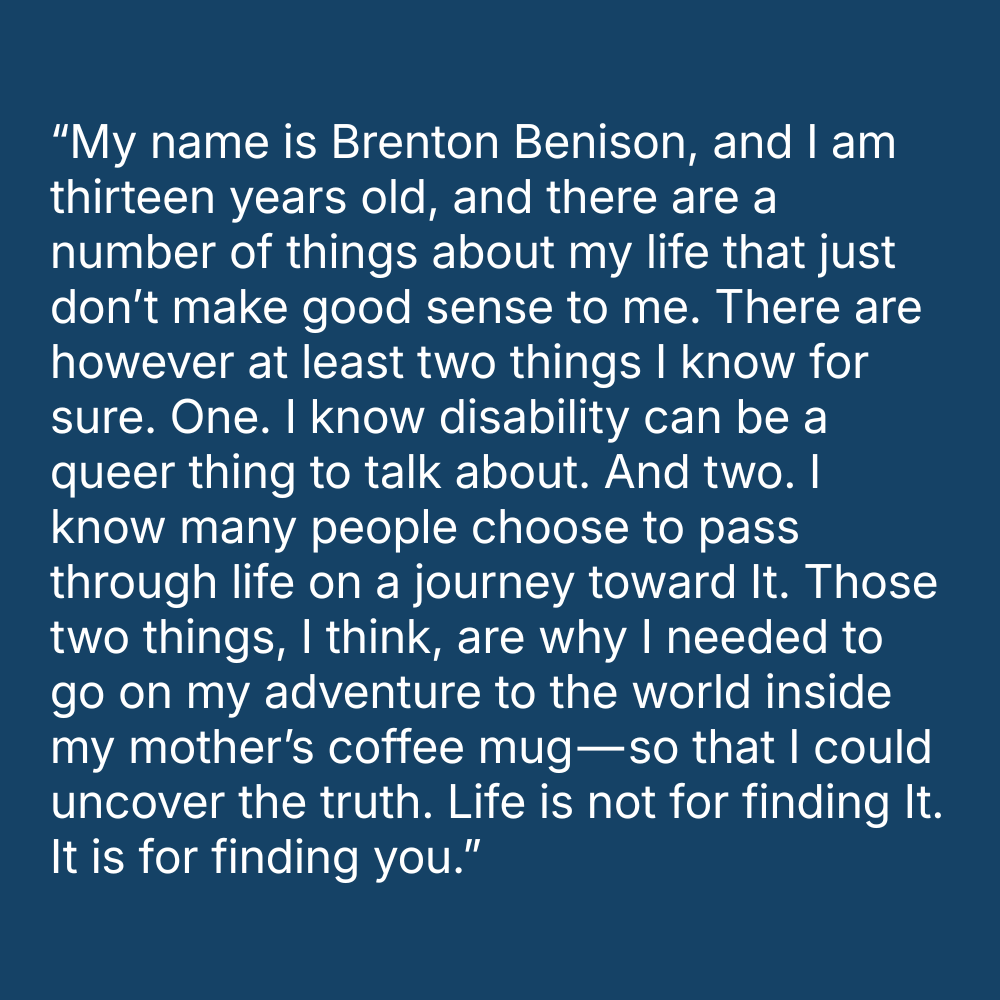
I’ve written elsewhere about my intention to revisit a novella I wrote over a decade ago about a world inside a coffee mug, as excerpted below:
“Light-Roasted Spider Fems is a re-imagining and expansion of a fantasy novella I wrote and published on a limited-run of approximately 100 copies more than ten years ago about a boy who falls into a coffee mug. I wrote the novella while living in Accra, Ghana in 2014 learning about disability activism. Rereading it in 2025, I expected to be embarrassed by the quality of my early writing and the ways it lacked the greater nuance and sensitivity that I now bring to social justice and disability issues (and I was). But I was also confronted with a raw, stream of consciousness snapshot of my 20-year-old self processing my disabled, neurodivergent, and queer identities while grappling with trauma related to the Boston Marathon bombings. I also found myself exploring my emerging awareness of the intersections between ableism, capitalism, and other types of social injustice and how I relate to movements working to dismantle them and to envision new realities. Approaching this novella with fresh curiosity, I decided it would be interesting to revisit that same world with a new story that explores internalized ableism, disabled identity development, learning and unlearning, saviorism, and the emotional aftermath of an explosion. In doing so, I hope to honor the story’s original intent in a reflexive and thoughtful way by writing disabled characters and using the profits from any sales to advance projects aligned with disability justice in Ghana and other settings in the Global South through the Lyra McMahon Social Justice & Political Solidarity Fund.”
I have written elsewhere about the cultural heritage of Anansi spider tales in Ghana and my personal connection to them over the years. While this re-write will not be a true Anansi story, I am intentionally referencing this story-telling tradition in the new title for this work.
Overall, this is a project I hold somewhat sensitively, because for years I felt embarrassed by it. In addition to the issues described above, several readers also told me the book didn’t make much sense, that it was too “out there,” and I took that feedback more harshly than I needed to. The book was tackling questions and themes that still matter to me today, even if I wasn’t yet writing with the care, specificity, and clarity I write with now.
I have conceived this project of revisiting the novella in three parts: (1) fully rewriting a new story in the same world as the original novella that honors its themes and also repurposes text from the original, (2) writing a reflexive, autoethnographic essay(s) to accompany the updated novella/novel to describe my journey with writing and re-writing this project, mistakes and corrections I made, and what I learned along the way, and (3) publishing the updated novella/novel via traditional or self-publishing and using any profits I generate to help fund global disability justice projects that I have remained engaged with over the decade since writing this.
I’m writing this essay as an early step in the process of rewriting the novella. By sitting with quotes from the text that still resonate with me, or that continue to teach me something upon rereading them, I’m trying to challenge the self-consciousness I feel around the work. I hope this activity will help me to approach this project with curiosity instead of moralization, and with less defensiveness about mistakes I made along the way, which I will also examine explicitly through the autoethnographic essay(s).
With that introduction in place, I will turn now to the quotes themselves. I’m not offering these excerpts as a defense of the novella necessarily, but as a way of appreciating it enough to warrant my revisiting/engaging with it again. I’ll move through sixty quotes — one from the foreword, a few from each of the sixteen chapters, and one from the afterward.
Foreword
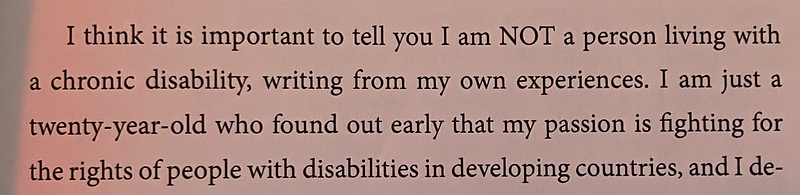
This quote from the foreword captures some of the main shifts in my perspective over the past decade. First, I was careful then to clarify that I was not a person with a chronic disability writing directly from those experiences. Rather, I understood myself as someone with intermittent and invisible disabilities — experiences I assumed didn’t matter enough to claim, which is why I made the main character physically disabled. I also did not see yet how the book was about my own experiences with disability, as I tend to write at more of a subconscious level. Second, while the book engages with ideas I now locate within critical disability studies, I was still linguistically approaching disability through a human rights framework, which is reflected in my use of the term “rights”. Third, my use of the phrase “developing countries” reflects the fact that I had not yet adopted a decolonial perspective in my understandings of social justice globally.
Chapter One
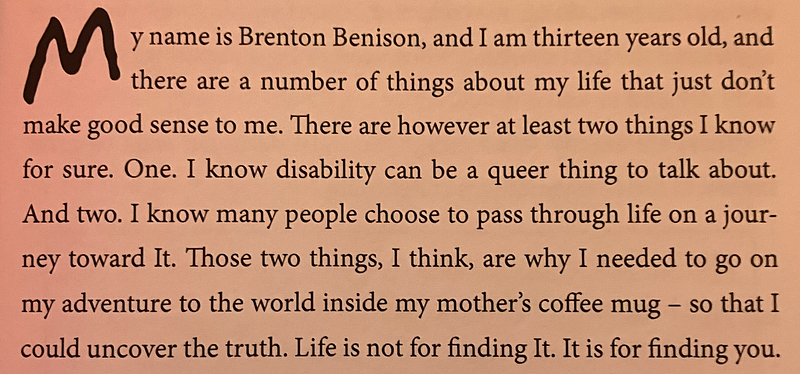
While I didn’t fully recognize this at the time, the line “disability can be a queer thing to talk about” now strikes me as a powerful way to name the deep intersections between queerness and disability, including the shared roots of queer and crip theory. Throughout the novella, there is also this idea of “It” which essentially represents a mythological land of normalcy everyone is supposed to aspire to. Brenton the main character rejects this, which speaks to the ways I was rejecting “It” in my own life at the time.
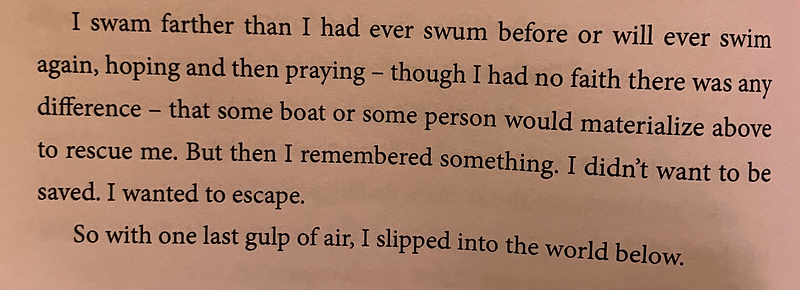
In the opening chapter, Brenton decides whether to jump into the world inside his mother’s coffee mug, and he decides to go. His choice is summed up in the line, “I didn’t want to be saved. I wanted to escape.” The theme of saviorism recurs in the book, reflecting something I was grappling with at the time as a queer person, navigating others’ impulses to “save” me, and as someone engaged in international disability rights work. I was asking then repeatedly: what were the appropriate ways for me to engage with this work? While there were certainly moments when I participated in white and disability saviorism tropes (i.e., through my words, actions, and even in how I tried to market this book), revisiting it now also reveals how my I was actively pushing back against those very dynamics in my writing.
Chapter Two
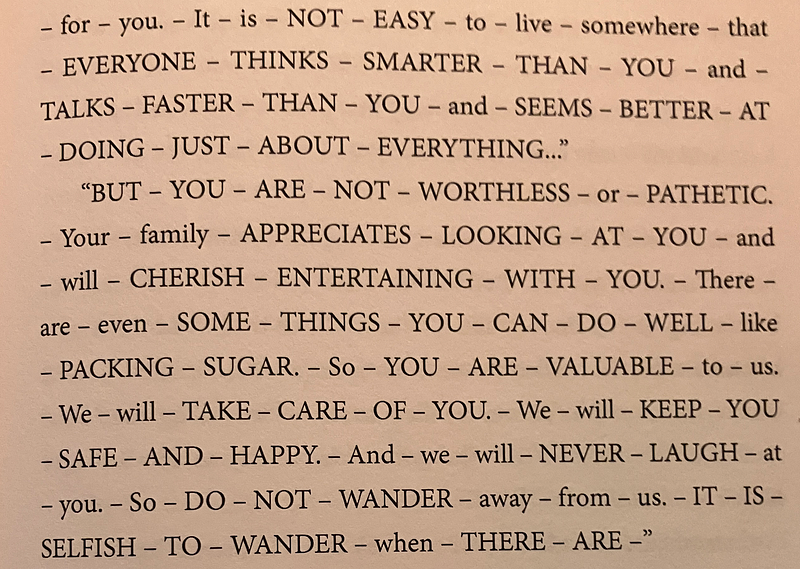
The second chapter of the novella is a crash course in the charity model of disability, with Brenton landing in a family that perceives him as disabled (i.e., “dumb and dinky”), who pity him, and who immediately impose extreme limitations on who he is allowed to be and what he can do. When Brenton rebels against this, he is immediately arrested by the city guard, who put him in a cell, emphasizing how Brenton’s deviance as a disabled person is understood as socially unacceptable and dangerous.
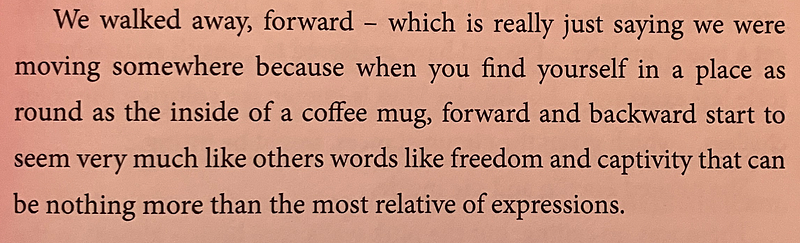
This quote is a pointed critique of capitalistic American society (which the city in the novella represents) and how it emphasizes individual freedom but at the same time controls us culturally, structurally, economically, and politically. This is one of the novella’s first attempt’s to suggest a connection between disability/ableism and capitalism.
Chapter Three
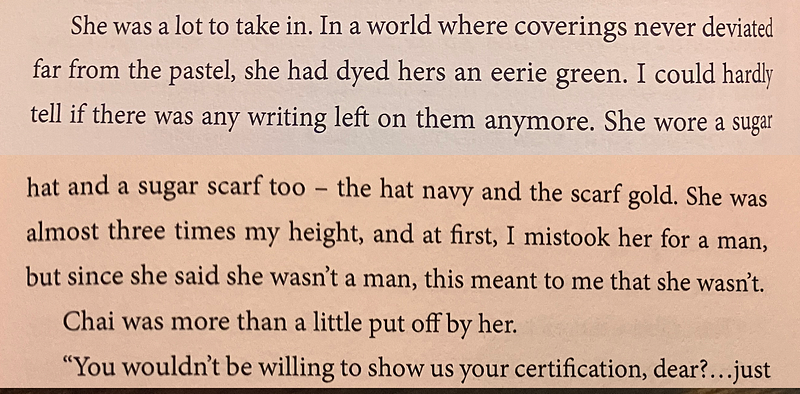
The third chapter opens with Brenton meeting his first in a series of ‘guides’, who is presented as a genderqueer/trans person. I don’t remember identifying as trans until more than a year later, and so it was interesting to see such a clear representation of genderqueerness in my writing. This reminds me of something important — sometimes we know things before we know the name that others have given to them.
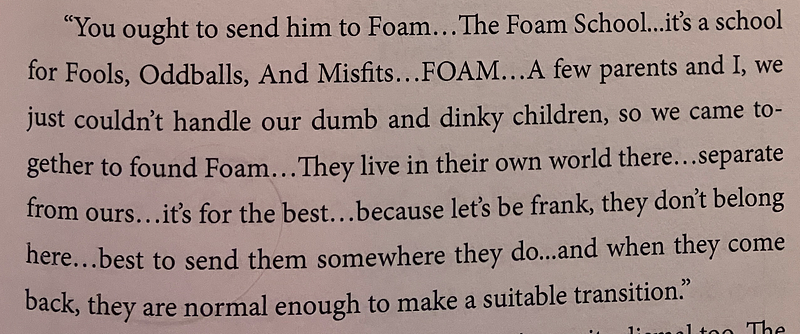
The chapter then turns to a very on-the-nose exploration of integrated vs. segregated school for disabled children and also the role of parents in shaping the lived experiences of disabled and queer children.
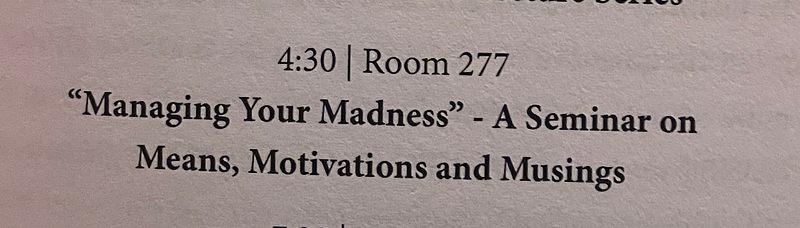
While I did not use the word mad to describe my brain until years later, it was again interesting to find madness mentioned several times in the book, with this being one of the first mentions.
Chapter Four
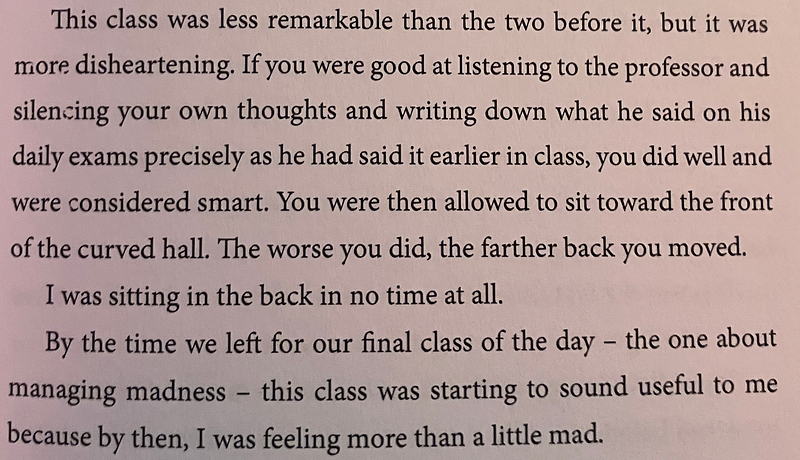
I was also surprised to find that I already understood madness to be something that is constructed by institutions and society, as Brenton identifies his madness as relating to his experience navigating school.
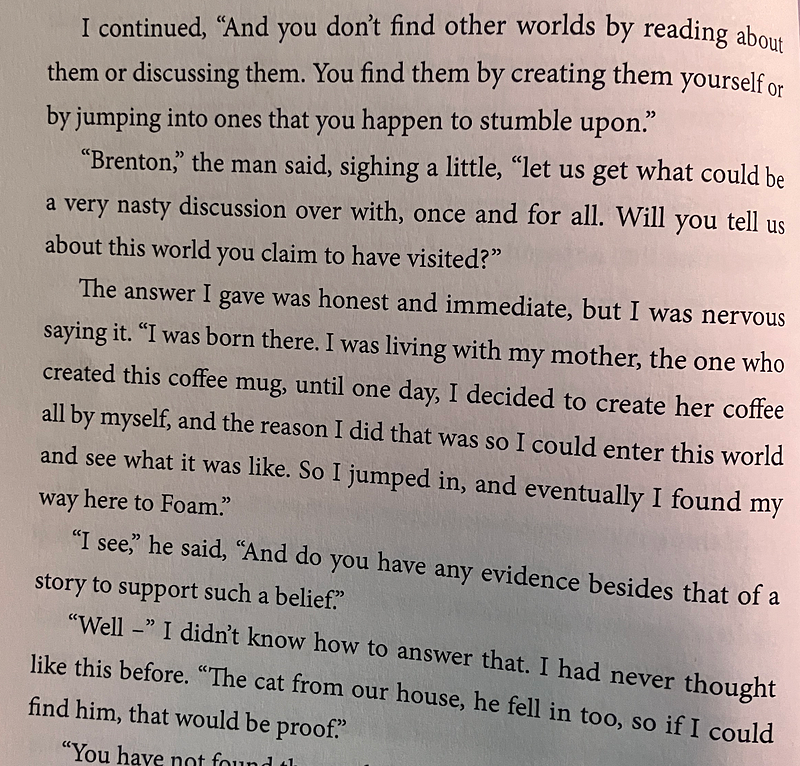
The chapter then shifts into a classroom setting where there is a debate about what constitutes knowledge, and Brenton experiences the confusion and hurt that comes when people doubt or question your lived experience.
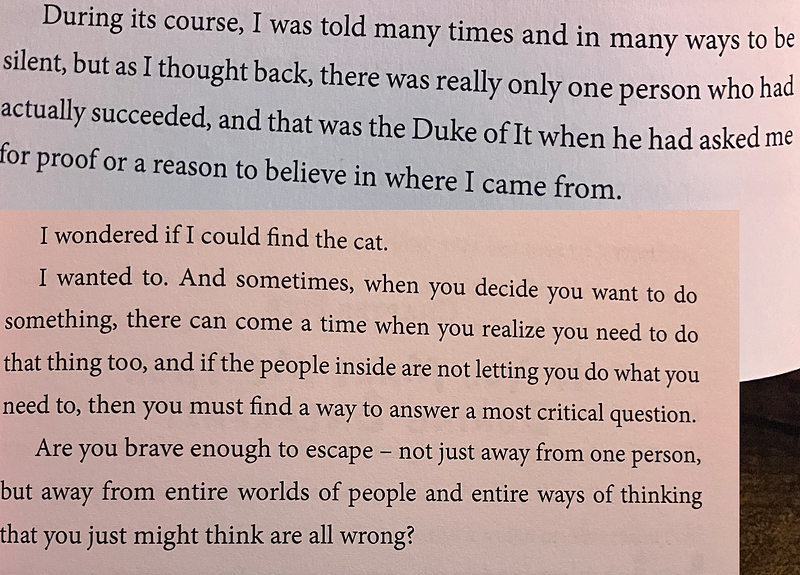
The chapter concludes by identifying that Brenton is not just escaping from individual people who are trying to constrain and marginalize him, but entire ways of thinking (i.e., ableism, heterosexism, and transphobia).
Chapter Five

The fifth chapter opens with the observation that actions done in the name of the protection and safety of certain people can actually be means of controlling them and keeping them from freedom.
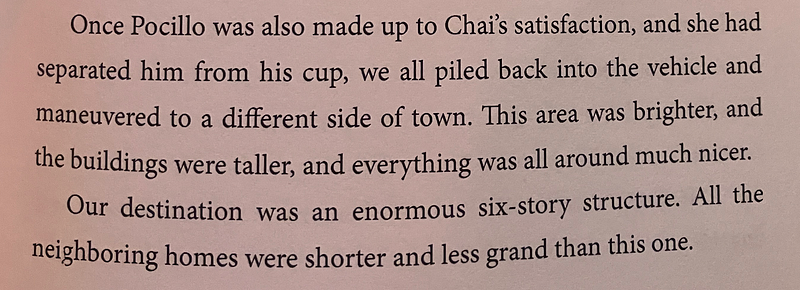
The dinner party that Brenton’s parents take him two introduces the idea of class within the city, and how much of the behavior of Brenton’s parents is driven by their desire to appeal to their friends in the upper-class.
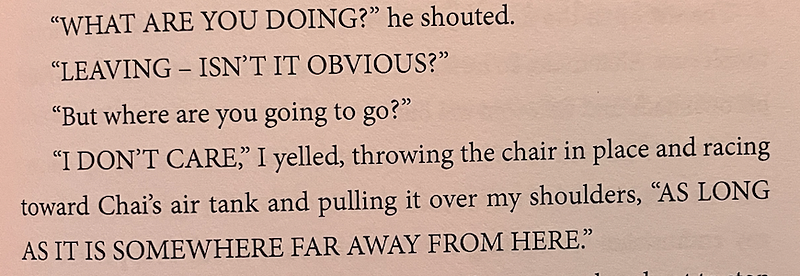
In this chapter, Brenton finally makes his escape from his family and the city he finds himself in. He doesn’t have a clear plan but is motivated to escape by the emotional harms he has experienced. He has had enough. I found this relatable to my journey of “escape” from environments and relationships that have felt like traps to me. That escape was not well planned out but rather occurred suddenly acting on emotional impulse.
Chapter Six
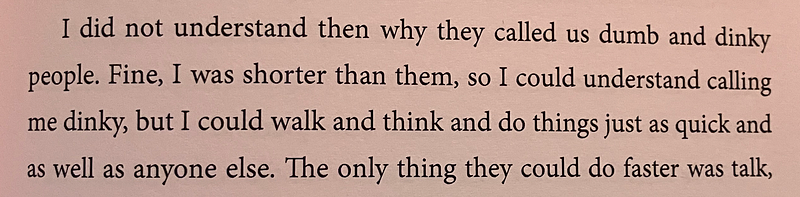
This passage highlights how part of Brenton’s escape involved challenging the language other people used to describe him. While he did not yet know how he wanted to be defined, he recognized what felt wrong to him. I feel like this resonates with how a lot of people come to identify as queer and trans and disabled; it is through realizing they are not straight, not cis, or not able-bodied/minded and asking: who am I then?
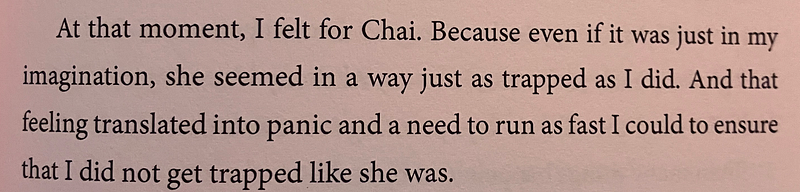
This quote is doing multiple things. First, Brenton empathizes with the people oppressing them, seeing how they are also oppressed by the systems they partake in. Second, seeing how decent people could get trapped in these systems and become something terrible scared Brenton deeply and was one of his major impulses in running away.

Brenton’s escape would have proved short-lived, if he was not soon aided by two people (who were both queer and affiliated with the trans character). While no one is physically harmed in the sugar bombs, Brenton’s escape also occurs through some amount of violence.
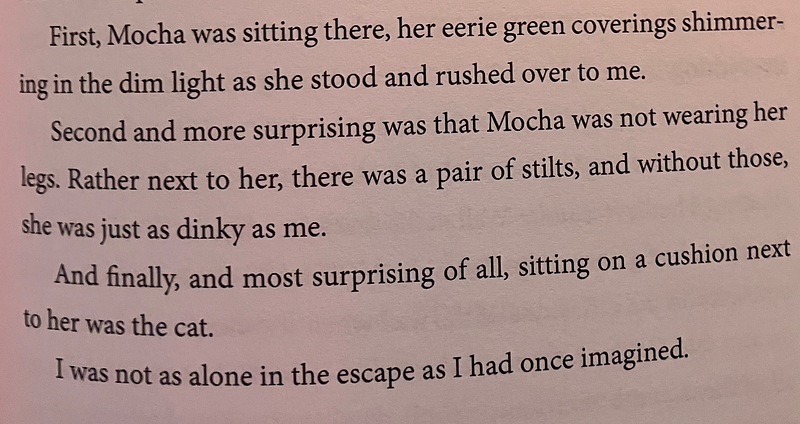
The chapter ends with several reveals. First, the trans character was deliberately passing as nondisabled, despite being disabled, and working to help free Brenton (and others like him). This is a subversive act that is turning societal attitudes about disability on their head and using them in the pursuit of freedom and justice. Secondly, the trans woman has the cat from Brenton’s world with her, which symbolizes that not only does she believe Brenton’s lived experience, she has the ability to help him prove it. Brenton concludes with the realization that he is not actually alone.
Chapter Seven
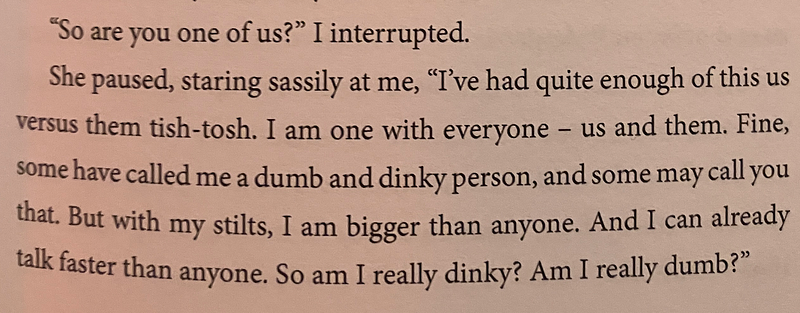
When Brenton asks the trans character if she is “one of us” (i.e., disabled), the character responds by aggressively dismissing labels, questioning the meaning of the societal categories they have inherited. This highlights one of the definitional tensions with disability — how it can exist in relation to social and political norms that we as disabled people are also resisting.
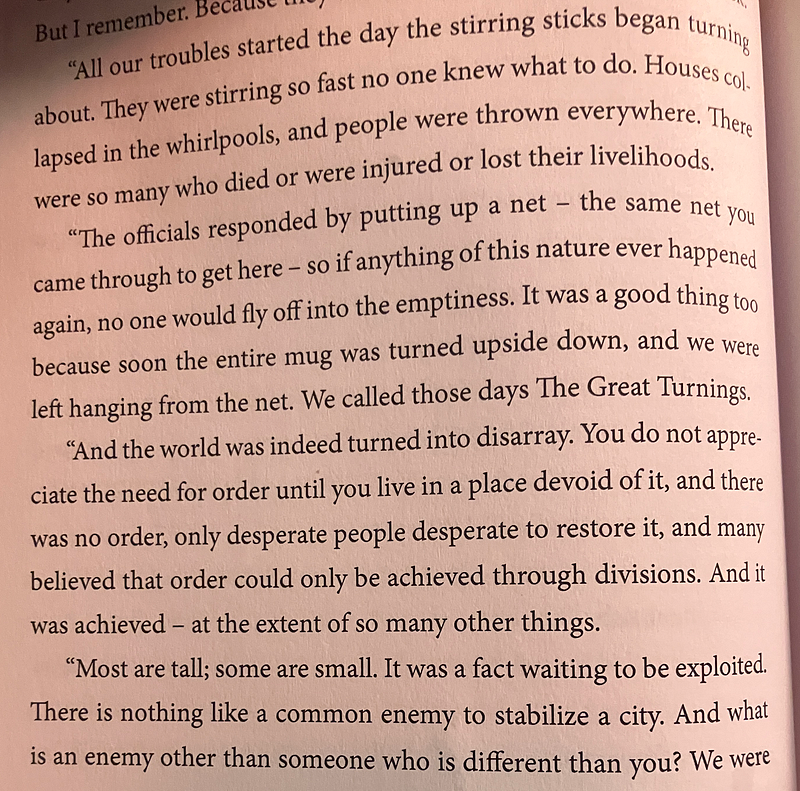
The next section of the chapter provides a background to the history of the city — how it was formed in response to environmental disaster. From there, there was civil unrest, which was quieted by making out the disabled population to be a common enemy and removing them from the city. This was followed by the construction of a net/wall to keep people in and out. The nature of difference is described in terms of bodily characteristics (height) which suggests relevance to racism and other systems like racism.
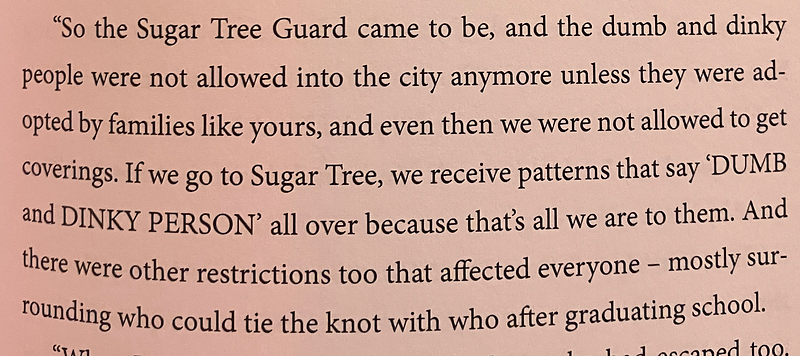
The creation of the wall led to the creation of a military force to defend the city, and most disabled people were locked out of the city where they were (a) not protected from environmental disaster and (b) locked out of resources. For those disabled people allowed in the city, they were second-class citizens with rules applying to them, such as who they could marry. This is another one of the novella’s explicit connections to queerness.
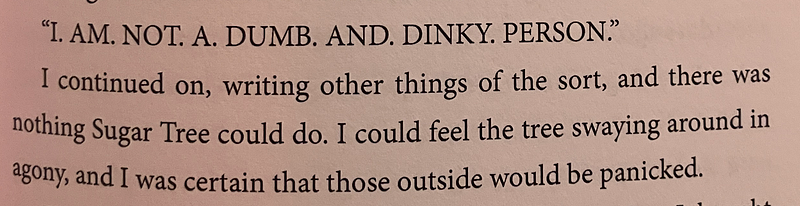
Brenton quickly discovers that the people who helped him escape have their own agenda; they want him to help them do a piece of activism against the Sugar Tree. He agrees to help but is ill-prepared for it, and the action ends up going disastrously wrong. This speaks to how disabled and other marginalized people are often thrust into activist roles in their communities even when they are not entirely ready for them. This also marks Brenton’s first defiance of the language society has imposed on him. The Sugar Tree, which represents religion and how the city is weaponizing it, is the source of this language and is also the site of his rebellion.
Chapter Eight
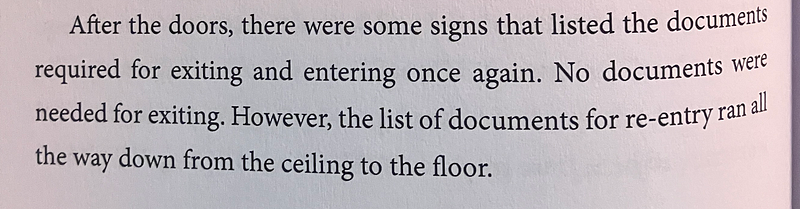
After a short chase, Brenton and his friend soon escape the city, where they are confronted with the reality of the world outside the wall. As they pass through the wall, the idea of the city having a regulated immigration that controls entering (but not leaving) is referenced.
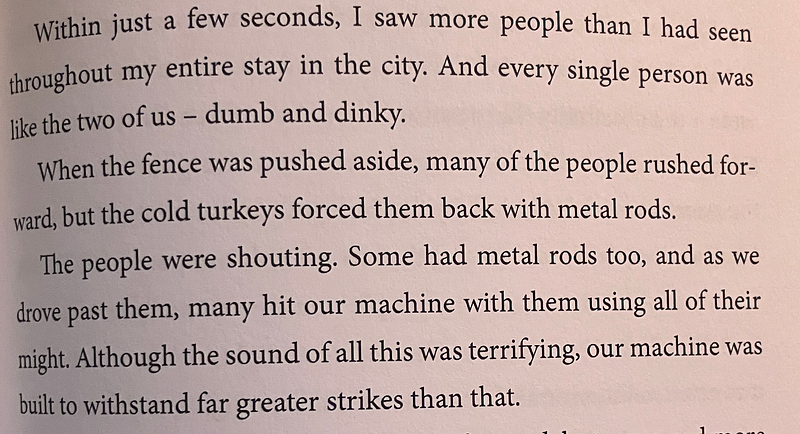
As soon as they leave the city and enter the world beyond, they confront a mob of disabled people (like them) fighting to re-enter the city.
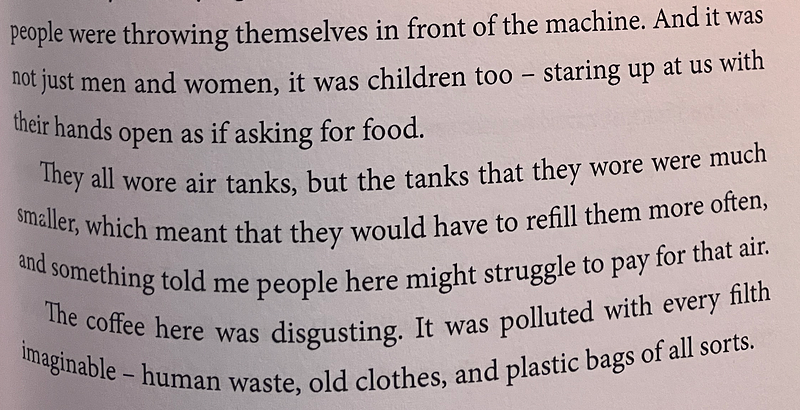
This passage introduces several ideas about the world at once. First, the people outside the city do not have the same access to food as people in the city, and many are starving. Second, air is regulated and paid for, and people outside the city struggled to pay for the air they needed to survive. And third, the world outside the city lacked the same sanitation and waste management systems as the city and served as a dumping ground for the city’s waste (e.g., old clothes and plastic bags).
Chapter Nine
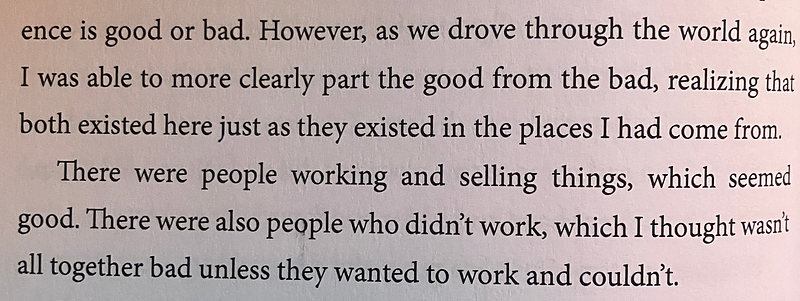
On his second day in the world outside the city, Brenton expresses a more nuanced view of this world — seeing strengths and positives in addition to the problems he notes on the first day. He also recognizes that people are surviving via commerce/capitalism and places a value judgment on this — that it “seems good”. He also sees however that there are some people who are functioning in different ways outside this mode of production.
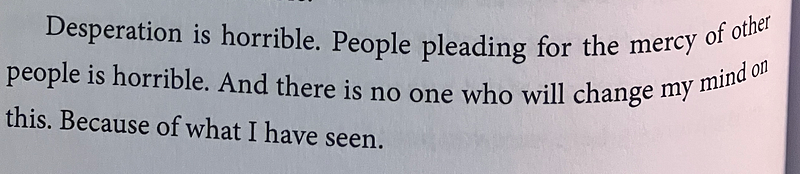
Brenton also shares a more nuanced view on the world outside of the city on his second day — that his main concern with it is “desperation” and how people I forced to plead to the city for their own survival.
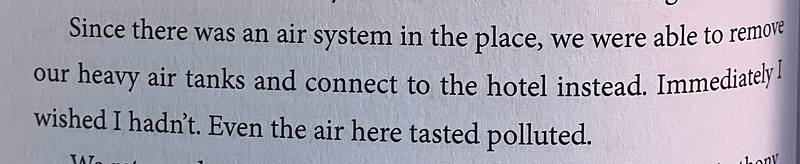
Brenton and his friend visit a hotel/hostel where they replenish their air supply, and he notes that the air here tastes polluted. This again raises environmental injustice issues related to the city polluting the air and water/coffee of the world outside the city.
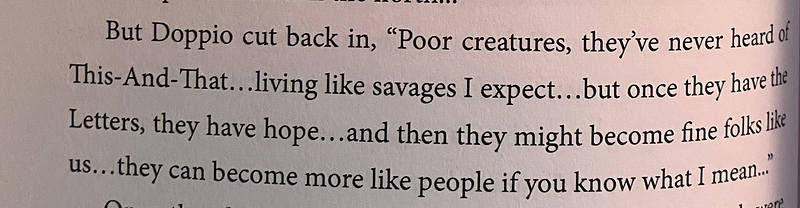
Brenton then meets two people who are described as missionaries, and what follows is a very on-the-nose critique of missionary activity, highlighting how the missionaries view the disabled people outside the city as “savages,” at least until they read the Letters (the Bible) and come to believe in This-And-That (Christianity).
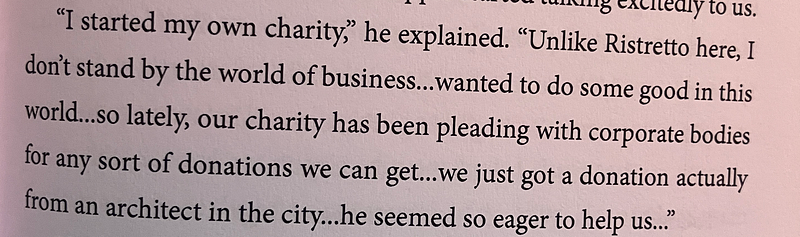
The ways in which missionary activity intersects with charity / the non-profit system is then explored. This includes a specific naming of how charity often tries to smooth over the problems associated with capitalism while also appealing to those very same corporations for money.
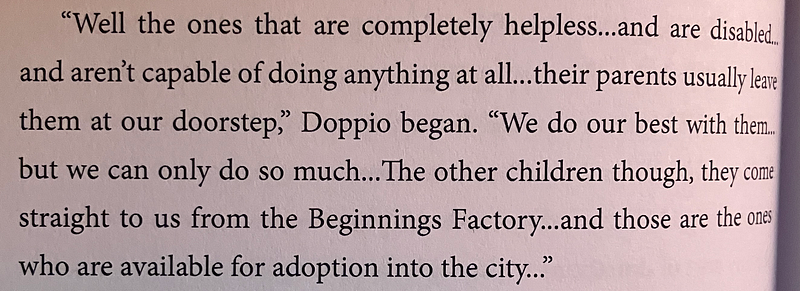
This next section explores how there are a certain types of disabled people who are abandoned by their families because they are viewed as too disabled to manage in this society. This is essentially a system of institutionalization for disabled people. An adoption system for children from the world outside the city into the city is then introduced, which importantly is managed by the charity and missionary system.
Chapter Ten
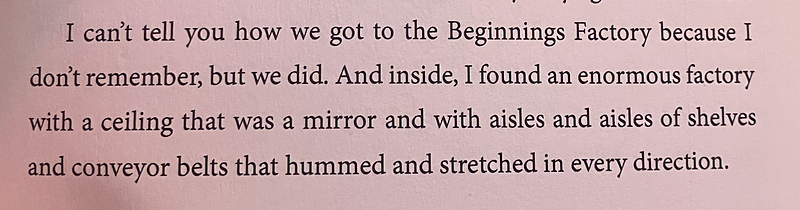
Outside the city, Brenton encounters various factories/farms that supply the city with vital resources, in this case the people themselves. This is suggestive of colonial modes of production.
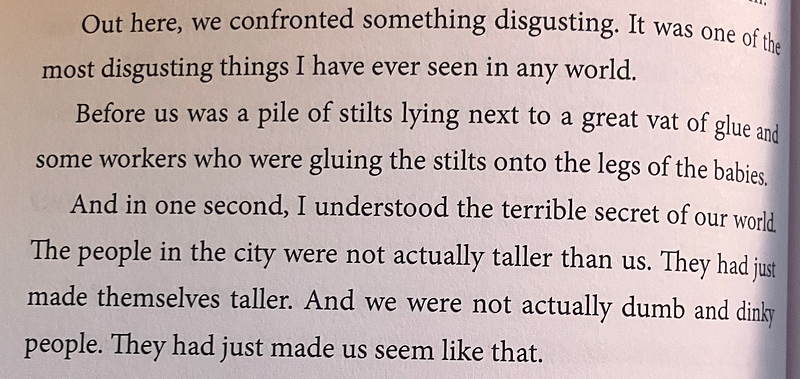
Brenton discovers that the difference between the disabled and nondisabled people is socially constructed at birth and then metabolized throughout their lifetimes of differences in access and opportunity. This reflects his understanding of the social model of disability.
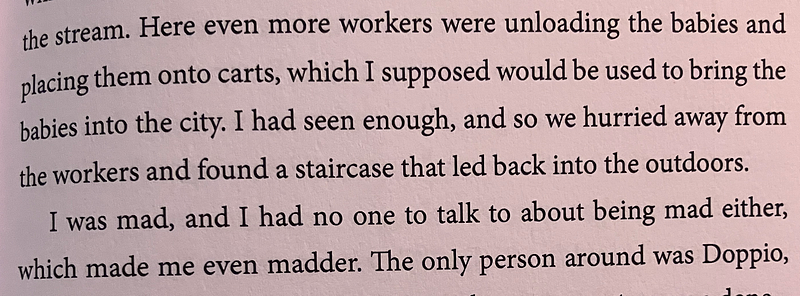
Once again, the word “mad” surfaces, and while it is partially referring to anger here, it is interesting how once again Brenton’s madness is a reaction to coming to understand the brokenness of society. Him being “mad” is positioned is positioned as a response to (a) witnessing injustice and (b) having nobody to discuss it with and share that madness with.
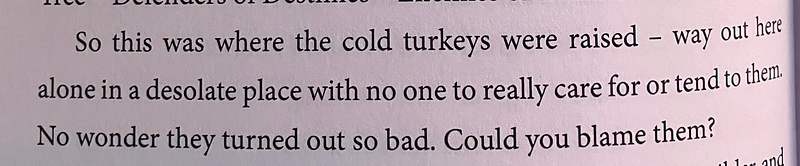
Brenton also discovers how the city’s military is produced by isolating disabled people from their families and raising them separately for this role in society. He feels empathy towards the people in the military who turn out that way and sees how it is not necessarily their fault. This relates to how American society often economically and otherwise marginalizes populations and then recruits them for the military and related roles.
Chapter Eleven
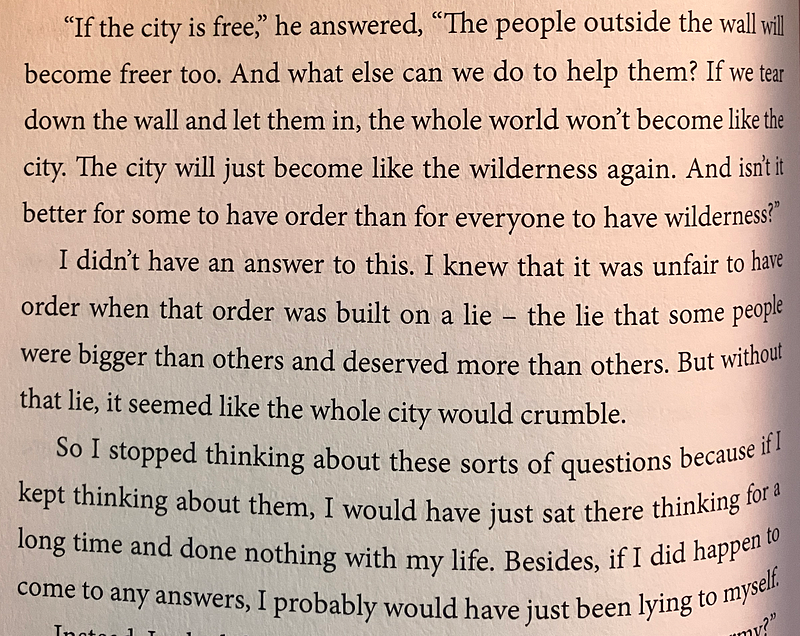
In this section, a character (previously portrayed as trying to control how knowledge is constructed) offers his take on freedom and order, suggesting that some type of order is necessary to prevent the world from slipping into environmental disaster (the reason the city was originally constructed). Brenton doesn’t accept this, and after noting that it wasn’t sensible or fair to build a city on a lie, he determines that if he continues to philosophize endlessly about this, it will impede his own freedom journey.
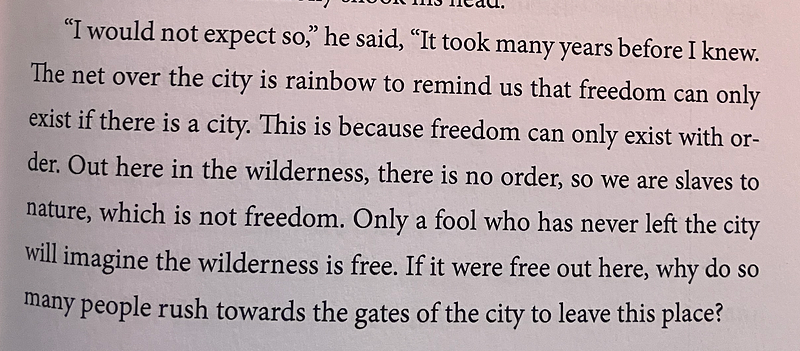
This passage, which is a continuation of that character’s worldview, could be read as an erasure of ways of living before the city (i.e., pre-colonial) and assuming that they were not free because they lacked certain infrastructure the city has. He also uses the observation that people from outside the city want to come into the city as evidence of the city’s goodness, ignoring how the city created the conditions outside the city. This directly connects to tropes in United States and other charity work that tries to “save” or “help” people whose living conditions are a result of colonization and economic systems in the Global North. While I did participate in some of those tropes around this time, I was also reckoning with them and challenging them.

If the novella has a thesis, amidst all its psychedelics and musings, it is here. Truth is not about arrival at some set body of knowledge; it is about a journey, a way of lifelong learning, and that is where freedom is found.
Chapter Twelve
When Brenton jumps into the well, he has a vision that is a hybrid of the world inside the coffee mug and his home. This is the first time it is directly revealed that Brenton has a physical disability and uses a wheelchair. This is one of the main reasons I have felt retrospectively uncomfortable with the book, that I wrote about a physical disability I did not have at the time. However, I can see now clearly that I was nonetheless writing from my first-person perspective as a disabled person about the social model of disability, and so the particulars of Brenton’s lived experience related to his physical disability were not a major part of the story. Furthermore, the reason I felt pressured to make Brenton physically disabled was because of my own socialized/internalized ableism that the types of disability I lived with were not enough to write about because they were not visible.

What follows is another on-the-nose exploration of “cure” and how “cure” is weaponized within religion. Brenton is brought into what amounts to a church service where they undertake a ritual to change him and make him nondisabled, which he does not want and does not consent to.
The novella discusses at a fair amount of length how religion functions to try to define disabled people, which Brenton rejects outright because he does not even understand himself and why he is the way he is. In this section, he insists on the ability and chance to define himself.

He also rejects interventions to change his body and who he is, identifying that being disabled is inherent to who he is and is not what he asked for.

Out of any claim in the novella, “I was afraid of being made helpless by people who did all sorts of horrible things in the name of helping me” is perhaps the most outright rejection of saviorism and types of helping that violate the dignity and consent of the people being served. Outside of disability “cures”, this scene is a direct parallel of conversion therapy.
Brenton is depleted after all this, to the point he almost gives up on life and succumbs to drowning. While this is not explicitly made out to be a suicide attempt, it suggests the life-and-death nature of this type of violence.
The chapter concludes with Brenton deciding he is ready to participate in activism. He has had an experience that has made him angry enough to act. He also recognizes that while others may be fighting for other causes and reasons, he had his own reasons, and it was not essential for others to understand his reasons for him to participate meaningfully in the fight. This again resonates strongly with my experiences of invisible disability and also queerness when I was closeted or not open about it— people not understanding why I was sensitive and aware of certain topics, but that being okay as long as I could still contribute in the activism/fight.
Chapter Thirteen
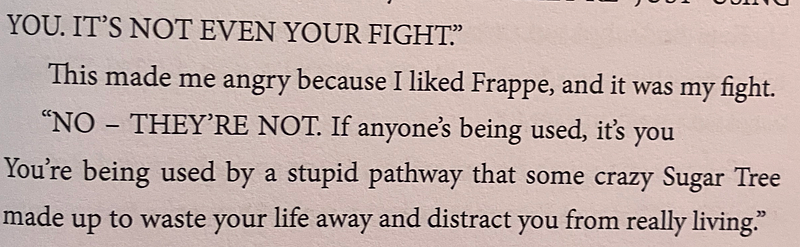
When Brenton and his friend have a conflict over the pathway forward (looking for It vs. returning to the city for activism), Brenton rejects the pathway towards It (the spiritual pathway towards some abstract, philosophical, ideal and normal place). He is offended that his friend cannot see how the fight was also his fight. In his anger, he deliberately uses disability-related language to describe this philosophy/religion as disabling (“stupid and “crazy”) rather than describing himself that way.
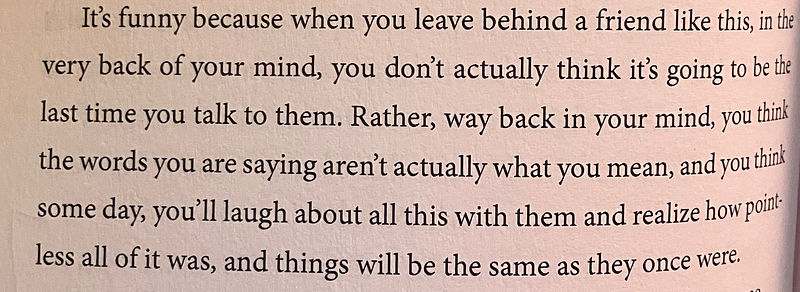
What follows is a nuanced discussion of the experience of losing friends over political and justice issues because they relate to your lived experience and you are unable to sacrifice them for the sake of the relationship.
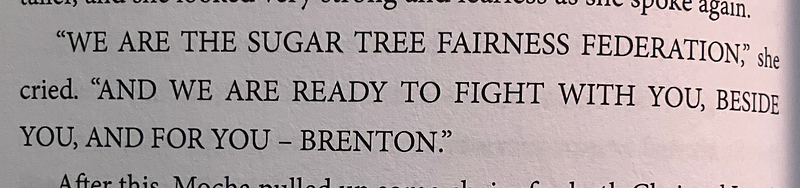
What happens next in the novella could be read as an act of saviorism on Brenton’s part — he is thrust to the front of a movement, despite lacking the experience of the others. However, importantly, this is something that occurs due to circumstance, rather than his active choice or desire. While he is consenting to it this time (he was not previously), he also has little control or direction over how his story and experience is being wielded. This speaks to a lot of the real struggles that occur in political and social justice advocacy when people’s lived experiences get tied up in causes and organizations that become bigger than their own. While the novella does not offer answers to this, it does raise this as a challenge and concern. Brenton wants to make social change and realizes his story is a way to do it, but is it right to center himself and what will be the impacts?
Chapter Fourteen
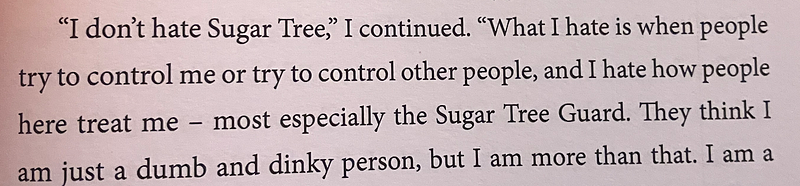
The fourteenth chapter is devoted to a series of advocacy speeches and then a political march to the Sugar Tree. Brenton makes clear that the cause he is advocating for is ultimately against the militarization of the city and how it is controlling disabled people. He also rejects once again the city’s definition of him and insists he is more than that definition.
In this chapter, I also want to acknowledge that I borrowed a phrase from a disability organization I was collaborating with at the time without asking permission for use in some dialogue, mistakenly assuming proximity implied consent. This was a mistake, and I will be removing it from future versions of the project. While the scene was informed by my experiences working with that organization and other disabled activists, that influence did not justify using their language without consent in a work I shared publicly, even with the intention that profits would benefit their work and related groups. This is the sort of ethical issue I did not hold with the same level of consciousness a decade ago but that I do today.
Chapter Fifteen
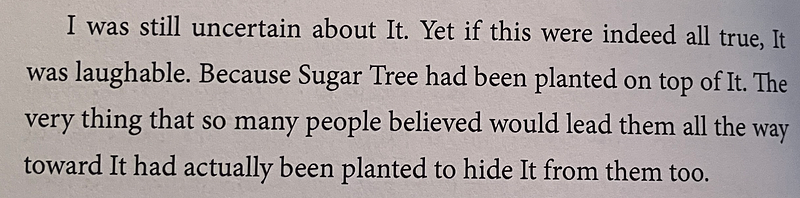
The fifteenth chapter opens with the discovery that the Sugar Tree (which represents religion) was planted deliberately to hide the entrance to the place the religion was encouraging them to find. This highlights how religion can be a source of manipulation rather than truth-telling.
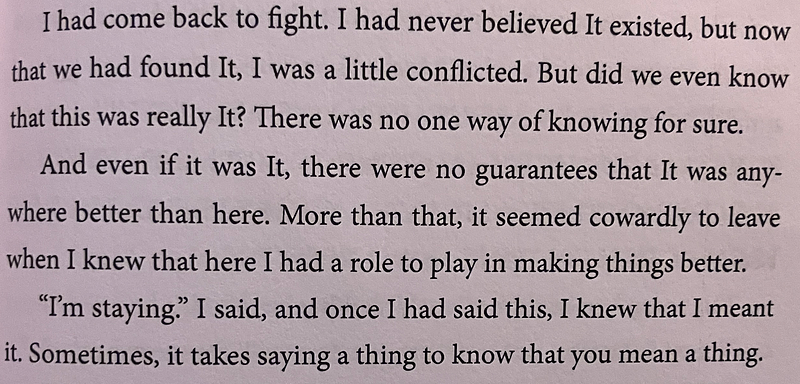
Brenton decides not to leave for It and is motivated to stay in the world specifically because he wants to participate in the freedom fight happening above him. He felt that he had some role in that fight.
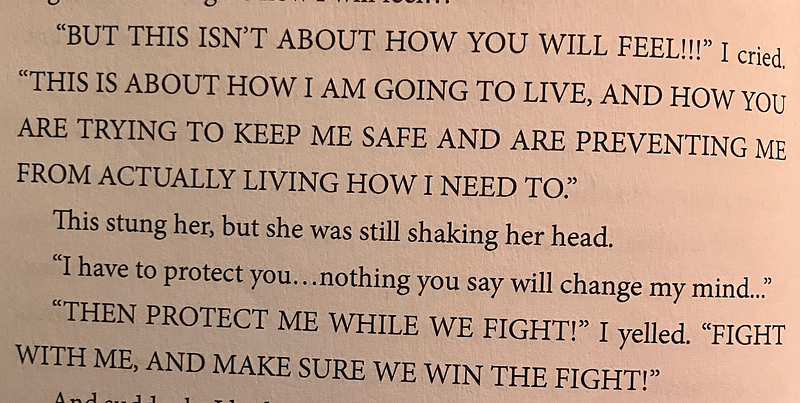
What occurs next is an emotional confrontation between Brenton and his mother, who wants to keep him safe by not letting him fight any further. However, Brenton insists that the best way for her to keep him safe is for her to fight alongside him and to help protect him during the fight.

The chapter ends with a powerful act of reclaiming. Brenton accepts everything they have written about him in this world being a “dumb and dinky” person and wears it proudly. This final action represents an acceptance of his disabled identity and him cripping how society has viewed him. This contrasts with how he talked even a chapter earlier about being more than a “dumb and dinky” person and being a person-first; here, he fully accepts and reclaims his disabled identity.
Chapter Sixteen

The final chapter of the novel concludes with a revelation that much of the story served also as an allegory for some events that occurred at Brenton’s school. Essentially, he was beat up and written on for being disabled. Brenton then thinks about to what extent whether what happened in the coffee mug reals and comes to the decision that stories we write ourselves can serve to demonstrate what we know about ourselves, a very meta comment as I return to reading this a decade later.
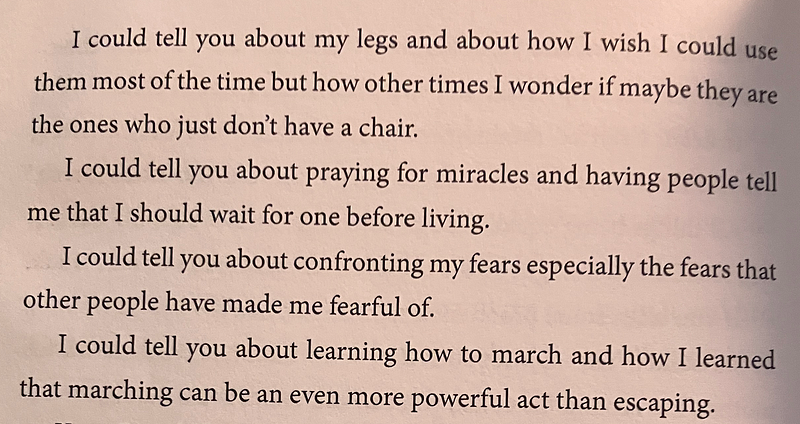
Brenton then directly connects many of the novella’s observations about the social model of the disability, the charity model of disability, and “cures” to his own experience as a child with a physical disability, noting how sometimes he does wish to not have challenges but also views those challenges to be largely socially constructed. This is an insightful take on the tensions between the social and medical models of disability, questions that have dominated disability-related discourse for decades.
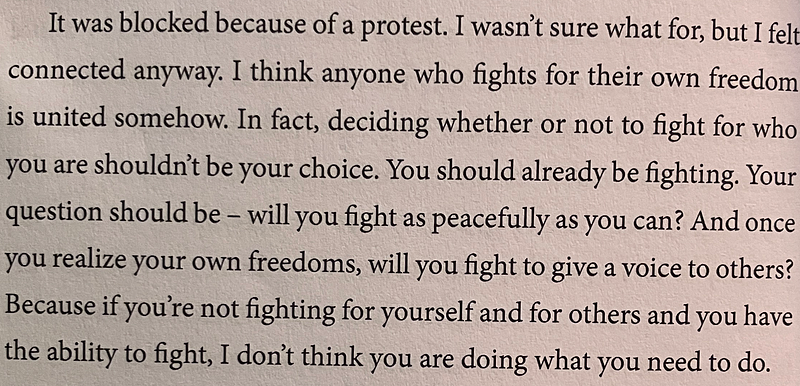
From there, Brenton concludes his reflections on advocacy with an explicit commitment to intersectional struggle, highlighting how movements are connected to one another and how people should fight for another (even when one movement may seem finished or to have won).

Brenton concludes by reiterating his commitment to the social model of disability and how other people’s impositions and limitations on him are what limits him, not his disability.
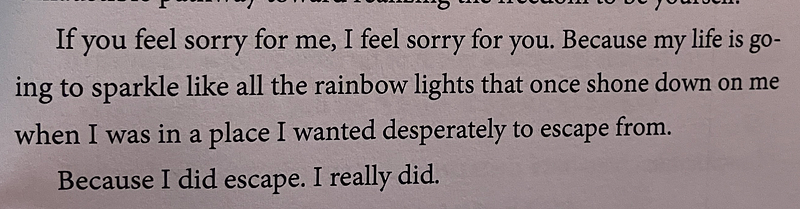
The novella concludes by making clear that although the book does deal with issues of political and social struggle, it is ultimately about Brenton and his escape from attitudes and ideologies that oppressed him.
Afterword

The afterword, entitled “Things You Could Do Next,” makes clear that while Brenton may have had clarity about his role in social struggles, I was still finding mine in real life. At the time, I was particularly uncertain how to ask others to support the work. The suggestions — follow the project website, talk to friends, volunteer with disabled people, learn about international disability rights, or seek travel opportunities abroad — reflected my privilege and were fairly superficial. I also asked people to post selfies drinking coffee from with a hashtag that included “mug shots” on social media, which, while thematically connected to the book, could be viewed as insensitive or trivializing to disabled people disproportionately impacted by carceral systems. For many years, I felt embarrassed about the potential harm caused by these promotional choices, but I also recognize that I was still learning and that only about a 100 copies of the book were ultimately sold. There also isn’t a definitive guide to contributing responsibly to disability-related causes internationally, and our global society as a whole continues to struggle with doing this work well.
I previously wrote a reflexivity essay in which I wrote critically about some of the mistakes and lessons I learned from this work a decade ago.
As part of ongoing efforts to align my work with justice and accountability, I have, at the time of publishing this essay, redistributed $500 of my income across four bail funds through the Lyra McMahon Social Justice & Political Solidarity Fund. This contribution exceeds the profits generated by the novella and serves as a concrete act of repair, acknowledging that the advancement of this work may have unintentionally come at the expense of incarcerated people. This redistribution reflects a commitment to ongoing reflection, responsibility, and solidarity with communities (such as multiply marginalized disabled people) impacted by structural oppression.
Concluding Thoughts
This was the first time I’ve read this novella in full over 10 years. And prior to doing so, I felt a significant amount of embarrassment about it and like it was something from my past that was extremely harmful.
There certainly were some mistakes that I describe above, including borrowship, centering myself in marketing, insensitive social media campaigns, and lack of nuanced awareness of my white privilege and explicit discussion of race/racism. But I think what I’m seeing clearly for the first time is that those missteps are not enough of a problem to warrant throwing this work out or erasing it from my life story or artistic history.
Instead, what I found upon revisiting this work was that while I did not necessarily know all the words, terms, and frameworks that academic and social justice spaces have given to experiences, I had a deeply embodied knowledge of what it means to be disabled, queer, and trans and how these relate to intersectional movements for social and political change.
This is who I was in 2014, at age 20.
I believe this novella is worth revisiting today in 2026, at age 31.
I hope to finish this re-write within the next two years.
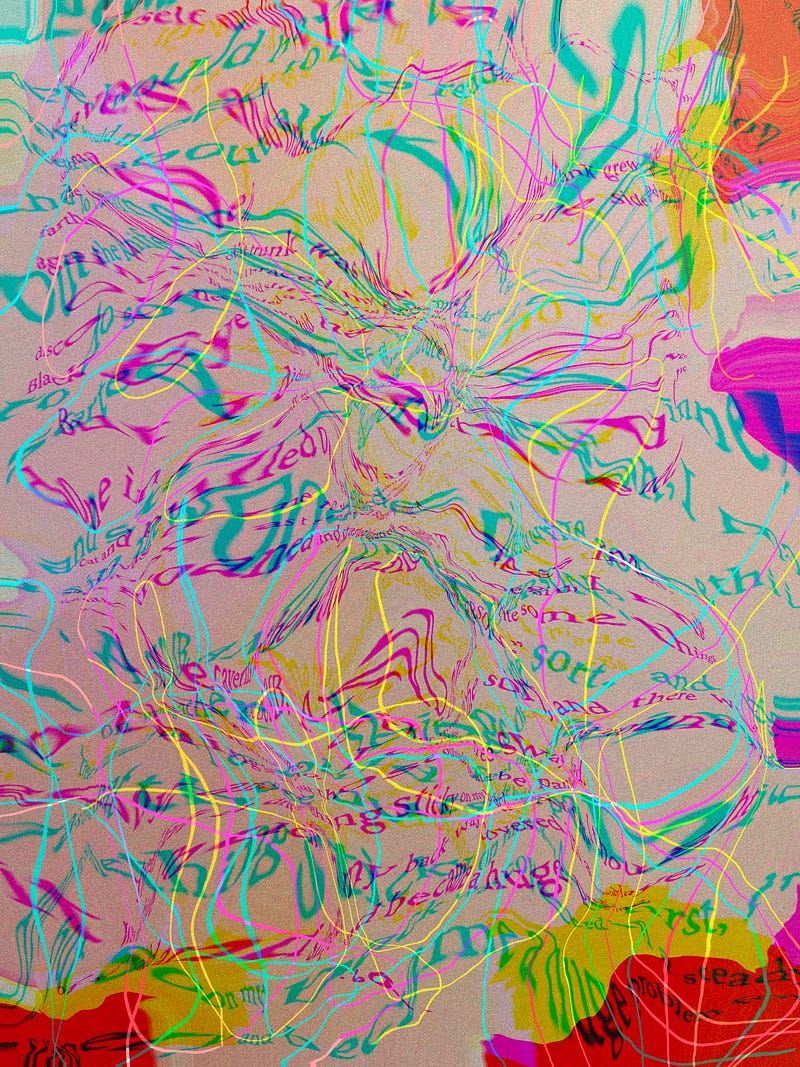
Note: As another act to transform the text, I launched “coffeestrings” (shown above), a visual art companion collection to my novel-in-progress, Light-Roasted Spider Fems, in which I am taking photos of the original text written, liquifying and manipulating the pages, and painting over them. This project may evolve over time.
